
Name the reason the last wave was difficult
Start with an observation you can make: a front unit fell early, the army failed to damage a durable target, a skill did not reach anything useful or the desired summon never arrived. These problems can all end a run, but they do not point to the same purchase. Another damage multiplier does little for an effect that never connects.
Review a similar stage when comparing changes. Moving to a harder setting while replacing every recipient makes it difficult to identify what improved. A short note about the limiting problem is more useful than a list of every item the run eventually owned.
Give the next spin a purpose
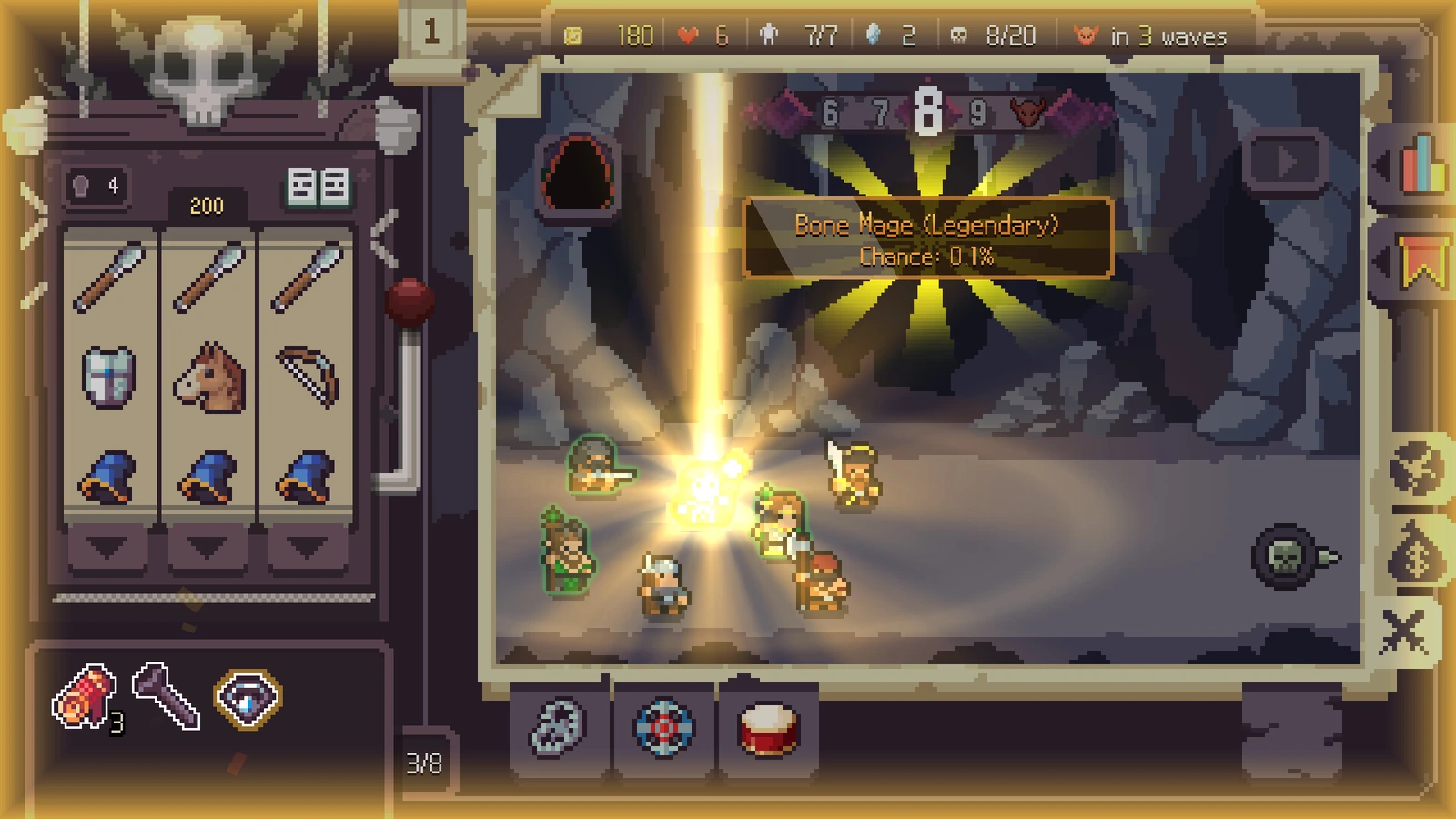
Another summon can provide a contributor, an absorption donor or an opportunity to reach a class checkpoint. Decide which of those you currently need. If the army is full, resolve the recipient decision deliberately rather than treating a new unit as automatically useless or a blocked machine as automatically broken.
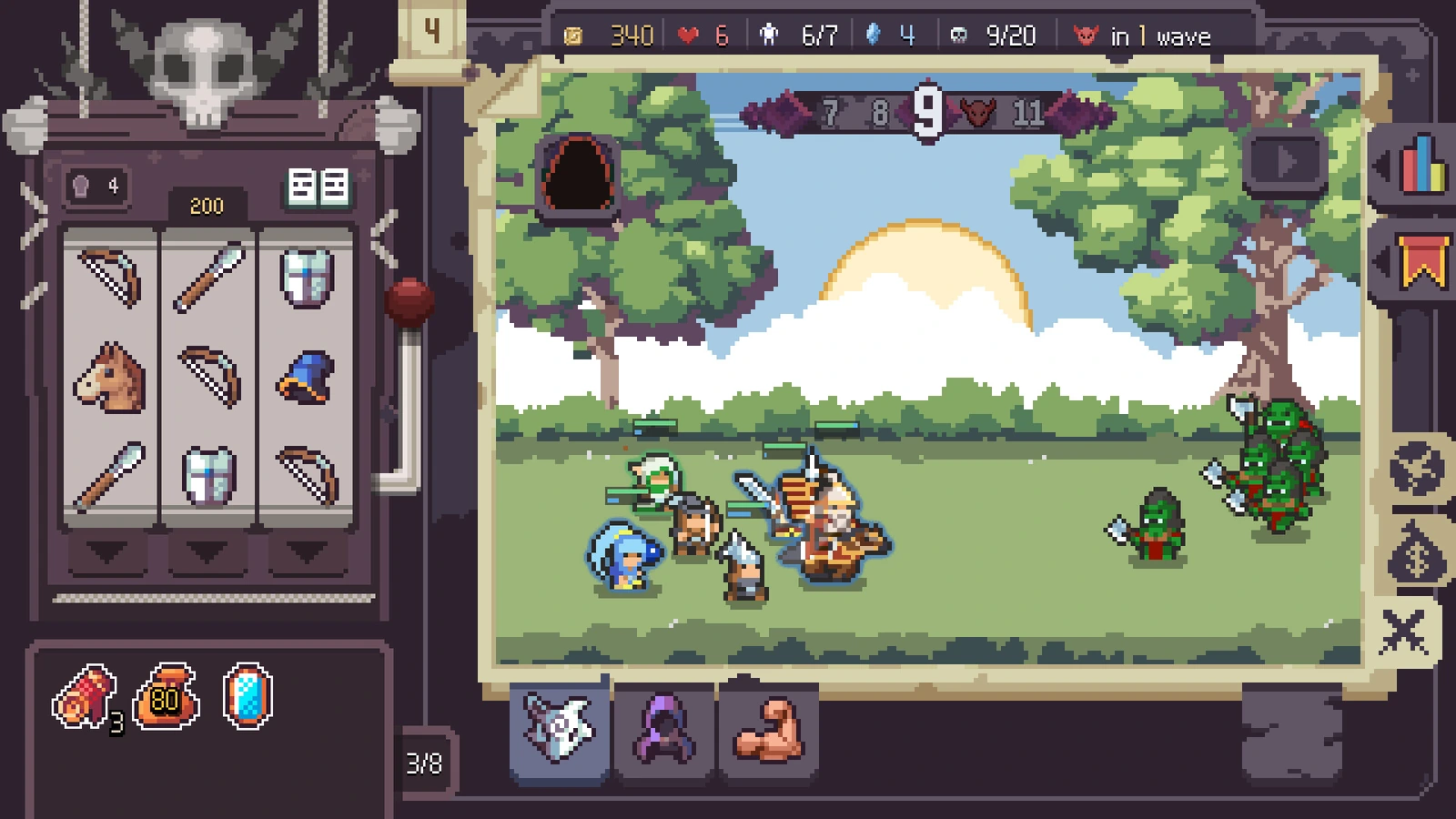
Read the next displayed price and keep the two resource budgets separate. Gold for spins and the blue resource used for recorded shop and Core-reroll decisions are not one interchangeable pool. A discount or extra opportunity still has to improve the army enough to justify the remaining budget.
A reserve should support survival
Saving for a later effect can be sensible, but the opportunity cost is the improvement you did not make now. If the current army cannot handle the next fight, an untouched reserve may never reach the planned future purchase. Compare a practical defensive or offensive upgrade with another speculative reroll.
The recorded player’s reserve preferences do not establish a complete economy formula. Use the current game’s prices and interest display rather than copying an arbitrary target from another account. Your useful reserve depends on what the army already does and what the next action actually costs.
Read normal-enemy and boss conditions separately
A crowd-control plan can feel excellent during ordinary waves and contribute less against a boss if its effect excludes that target. The reported Trickster branch is one example: temporary conversion is described for non-boss enemies. Keep an independent damage and survival plan for encounters where that condition is absent.
Similarly, a kill-driven or repeated-target payoff needs the right opportunity to occur. Before a durable single target, ask which part of the engine still works without a large group dying around it. This is a way to inspect the build, not a claim that every boss has the same mechanics.
Check who can actually affect whom
Range is a condition, not decorative text. Identify the source of a support or targeting effect and the ally or enemy it is meant to reach. If a placement change breaks that connection, the item may be doing something different from the job you bought it for.
The annotated 0.4-era example includes a late Hunting Mask range mistake, making this an especially useful pre-fight habit. Inspect your own units rather than copying an image’s coordinates. We do not invent a fixed nine-position army grid from the separate three-by-three slot machine.
Use permanent upgrades for the problem they address
When the issue persists across runs, inspect permanent progression. The cited player comparison distinguishes advanced-unit availability from army capacity: Advanced Research concerns the first, Command Limit the second. Faction choices point to their own meta-upgrade check. They are not a proven mandatory purchase chain.
Look at what is already owned before recommending another upgrade. If useful units are waiting but cannot be fielded, capacity is a different issue from never seeing the desired options. After choosing a purchase, keep the next run’s experiment small enough that you can tell whether the specific bottleneck changed.
THE NEXT USEFUL CHECK
Before the next choice.
Page-only preparation checks. Reloading clears these ticks.QUICK ANSWERS
One more useful detail.
Should every failed run be solved with more Command Limit?
Capacity is one possible bottleneck. If the problem is unit availability, damage or an effect missing its target, another slot does not automatically solve it.
Are all demo stages and difficulties available?
The official 0.4 update specifically announces Deep Cave through Normal. Use the current selection screen rather than applying full-game descriptions to every demo build.
THE SOURCE DESK / DEMO 0.4.1 CONTEXT
The reference behind
the next decision.
The publisher establishes the demo systems and updates. Detailed unit and effect examples are attributed 0.4-era observations. Our build plans and tier letters are editorial learning advice, with no claimed playtest or damage benchmark.
Open the references and their scope
- PublisherOptima Arch — official Slotbound Demo ↗
The 3×3 machine, absorption, Random Stats, Imprints, Items and Cores; demo identity.
- PublisherDemo 0.4.0 — The Jester Arrives ↗
Jester, Deep Cave through Normal, faction beta, Awakening, item rework, controls and planned Early Access.
- Independent guideSlotbound Hub — beginner worked example ↗
An attributed reading of Dabble’s run, including separate currencies, a late Jester transition and its anomalous reported result.
- Player discussionInaqea — Advanced Research and Command Limit ↗
Availability and capacity are distinct permanent-upgrade concerns; the comment is not a complete current price or probability table.
- Independent guideSlotbound Hub — permanent-upgrade comparison ↗
Choose by the current bottleneck rather than inventing a mandatory upgrade order.