
Published player-guide documentation is cited below. Read the current in-game tooltip and confirmation if your realm differs. PTR-only changes are not treated as normal-builder facts.
Three checks before the colour of the card
Eligibility: can your class receive the effect? Compatibility: is the relevant action part of your active role? Opportunity: does the fight give you enough chances to perform that action? These are separate tests. Passing the first does not pass the other two.
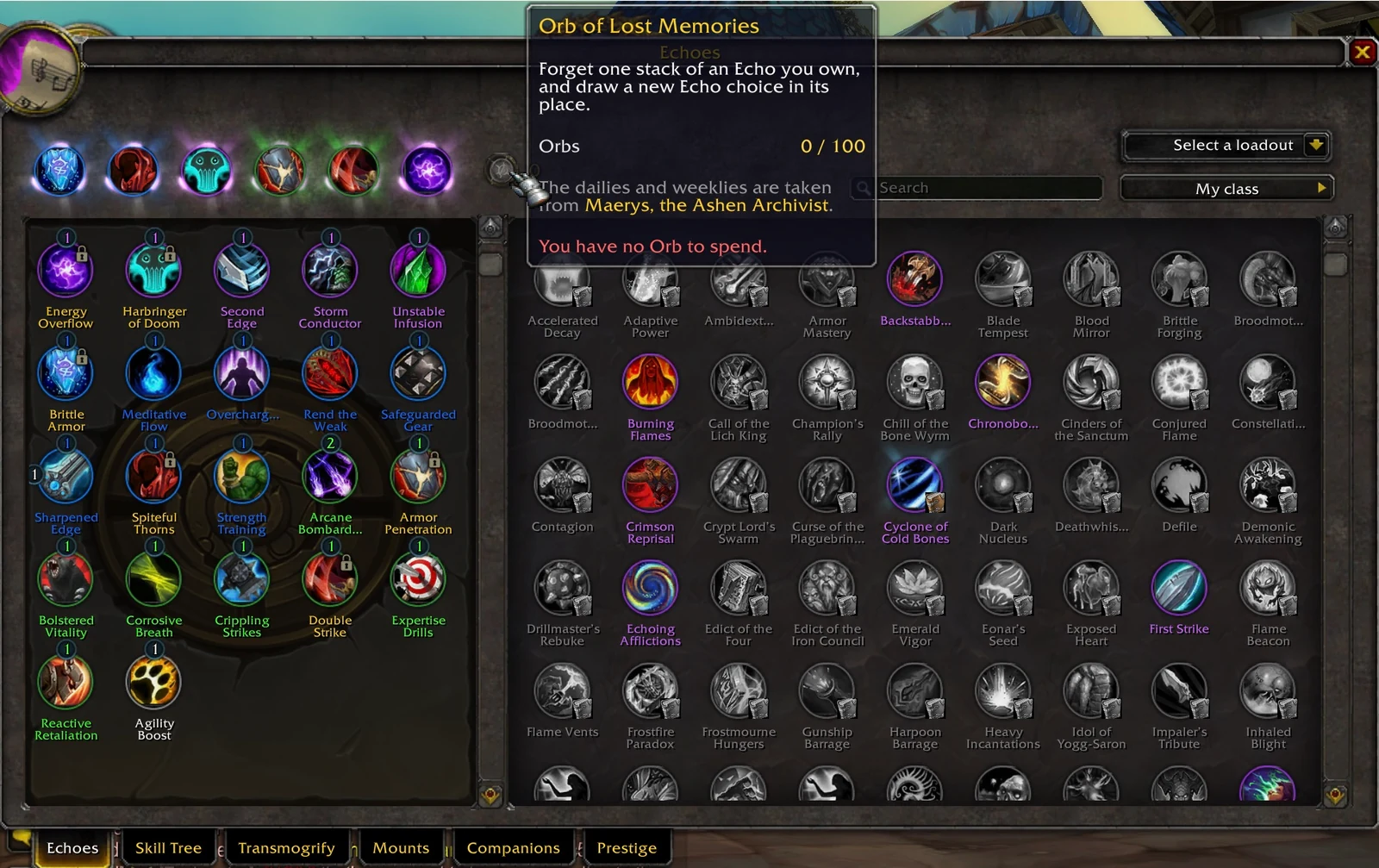
The default public catalog gives the same Echo name different triggers for different classes. Stonefist Barrage is a useful example: the Warrior record names specific strikes, the Hunter record depends on Auto Shot critical strikes with a chance condition, and the Warlock record depends on periodic damage with a chance condition. A familiar icon is not enough to identify the mechanic.
Build a short chain you can explain
Start with an ordinary action, identify its resource and timing, then attach an eligible effect. Finally, check where the resulting damage or support lands. A random nearby impact, a direct hit on the target and an effect on an ally are different practical results.
For a first experiment, stop at one main interaction and one supporting choice. If the result is weak, you can then distinguish insufficient triggers from a poor payoff. When four unrelated effects are added at once, the same result is much harder to diagnose.
A draft is a direction, not a promised draw
The published Echo guide describes card families and tools for changing or preserving offers. The useful planning habit is to distinguish a card you want from a card you have. Keep the ordinary build functional while waiting for a specific interaction.
If a choice screen does not contain your planned effect, prefer a card that improves the active sequence over one that only supports a future sequence. Read what a reroll, freeze or banish does in your current client before using the limited opportunity. This page does not simulate draw odds or guarantee that a wishlist changes them.
Name loadouts by the job they perform
The published loadout documentation describes separate Echo setups, and distinguishes a wishlist from an owned build. Use names such as “direct strikes”, “periodic damage” or “group healing” rather than “best build”. A useful name reminds you which action should make the effects work.
Before switching, inspect the resulting talents, equipment eligibility and active actions. A change that alters what you can equip is bigger than a cosmetic swap. Compare two setups in a similar encounter with the same role; otherwise the comparison tells you more about the encounter than the loadout.
Keep normal and PTR references separate
The project’s default builder loads the normal public catalog. Its V2 builder is explicitly described as PTR data for a later update. Our example cards were checked in the default catalog on 3 November 2026; new talents found only in the PTR are not silently inserted into those examples.
If a tooltip differs, use the text on the realm you are playing, then compare the correct official builder. Report a mismatch with the Echo name and realm or version shown. A screenshot of a preview is useful evidence of the preview, not proof that the live realm received it.
BEFORE YOU COMMIT
One clear plan.
0 / 5 checks complete
Temporary page notes. Reloading clears the ticks.THE EVIDENCE DESK /
Sources, scope & the next check.
Official references establish the documented mechanics. Starting builds, stat decision orders, tier placements and test suggestions are Cobalt’s editorial analysis. No damage simulation, measured win rate or hands-on realm test is claimed.
- Default official Echo Builder ↗
Public Echo names, class eligibility and triggers reviewed on 3 November.
- Default builder Echo catalog ↗
The normal /assets/dbc dataset, not /assets/dbc-ptr.
- Official guide · Echo choices ↗
Published guidance for draws, families and permanent slots.
- Official guide · Echo loadouts ↗
Loadouts, souvenirs and wishlists in the published V2 documentation.
- Default official Talent Calculator ↗
The normal public builder; separate from its PTR version.
- Official Talent Calculator · PTR ↗
Explicitly labelled test data for the next update; never silently merged here.