Keep a route between pressure and support
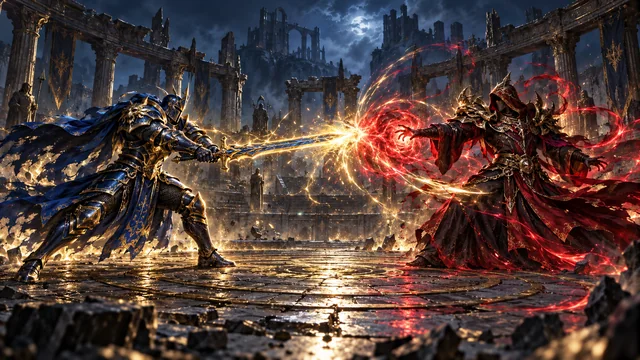
The public client includes Nagrand Ring, Ruins of Lordaeron and Blade’s Edge geometry. Hiding from an opponent is less useful if it also separates you from the partner who must help. Read the layout before approaching.
Choose a purpose: a casting angle, recovery space or an escape toward your teammate. Do not follow a target merely because it moves away; the next exchange may require support more than another attack.
Choose an answer to the danger that is happening
| Current problem | Decision to communicate | Common waste |
|---|---|---|
| Your partner is being pressured | Who supplies control, protection or recovery now? | Both players spending their largest answer on the same moment. |
| The opponent starts a dangerous cast | Who interrupts, if that tool can reach? | Overlapping an interrupt with a longer control without a purpose. |
| A damage window is ready | Which target is attacked and which is kept out? | Continuing damage on the target meant to remain controlled. |
| The attack has failed | Where do you regroup and what remains available? | Each player retreating in a different direction. |
A small call such as “I have the next interruption” gives the partner something concrete to preserve. It is more useful than announcing every button after it has already been pressed.
Read control categories and continuing damage together
The current global configuration gives diminishing returns a twenty-second reset after the previous control ends. That is a reason to inspect the category and current state, not to assume every differently named spell provides a fresh full-duration control.
Version 0.22.1 also changes continuing harmful effects: separate casters can maintain their own non-control applications, while controls remain restricted and stat-changing effects do not simply add together. Do not interpret that as unlimited stacking. Read the spell’s damage-break and target conditions before spreading pressure onto an opponent your partner intends to disable.
Preserve recovery when the fight slows down
Current configuration introduces healing reduction after two minutes, then increases it over time. A long exchange therefore changes the value of repeated recovery. Review whether your pressure is creating an opening or merely extending a resource problem.
Utilities need a suitable moment too. Bandage can be interrupted by damage; Infuse is an out-of-combat resource option. Tell the partner when you need room, then make sure the chosen position supports that request rather than exposing both players.
Turn the result into one adjustment
After a match, compare the plan with the result. Did you lose support, attack the wrong target, overlap answers or commit too late? Pick one correction for the next queue.
“Retreat toward the partner after a failed push” is actionable. “The class is bad” identifies no change. A toolkit tier cannot replace reviewing the exchange.
TAKE A PLAN INTO THE ARENA
Before your next match.
Tick items during this session. Reloading resets this page checklist.
0 / 6 complete
QUICK ANSWERS
Clear up the next decision.
Should I always attack the healer?+
Choose the target the current pair can pressure while staying coordinated. The opponent’s position, your available control and your remaining answers matter more than a universal target rule.
Does the tier list tell me which pair will win?+
No. It assesses the named utility-and-recovery profile from current tools. Selected talents, execution and the opposing team still change the result.
SOURCE REVIEW
Where the advice comes from.
Toolkit records were inspected from the original public client, version 0.22.1, on 31 October 2026. Suggested positioning, practice priorities and tier placements are Cobalt’s editorial assessment. They are not measured win rates or a tournament ranking. Server-side tuning and selected talents can change an exchange.
The supplied .net reference is an independent guide site with an earlier snapshot; the original game is hosted at arenaofchampions.live.